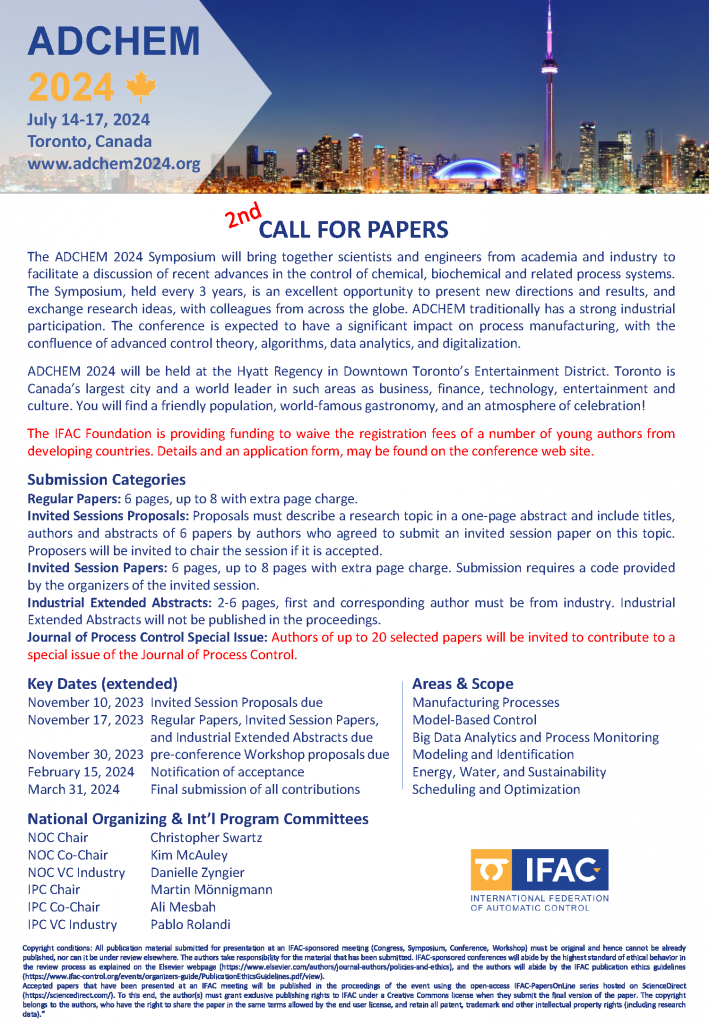
Due to many requests, the deadlines for submissions to ADCHEM 2024 have been extended. The new deadline for regular papers and invited session papers is November 17, 2023.
All other deadlines have been extended accordingly. Please see the attached call for papers, and visit www.adchem2024.org for details on all submission categories.
We look forward to seeing you in Toronto!
Best regards,
IPC Chairs Martin Mönnigmann, Ali Mesbah and Pablo Rolandi
NOC Chairs Christopher Swartz, Kim McAuley and Danielle Zyngier
Dear CSChE 2023 Systems and Control Division Symposium Contributor,
The Systems & Control and Energy divisions of the CIC will be putting together a conference proceedings of CSChE 2023 conference contributions, published through PSE Press as Systems & Control Transactions, Vol 3. Anyone who is presenting a poster or oral presentation in one of the Energy or Systems & Control division sessions is invited to participate. Participation is optional and it is free.
Here’s how it works:
Contributors are provided with a Word template to follow.
All presenting authors are encouraged to write a 2-8 page extended abstract for the proceedings.
Because it is an extended abstract, it is not peer reviewed. However the editors may request changes.
The conference proceedings will be published Open Access by PSE Press
The conference proceedings get an ISBN and are indexed with Library and Archives Canada
Every submission gets a unique LAPSE ID, with individual download tracking.
Material can be re-used in “full” papers. (Owner retains copyright). So it does not prevent anyone from publishing their work in a journal.
Extended abstracts can be cited journal style in Systems & Control Transactions.
The best contributions are invited for a full paper submission in a special series in Canadian J Chem Eng.
There are no fees to the authors.
Extended abstracts from CSChE 2021 and CSChE 2022 have received about 150-250 downloads each, so people actually read and use them.
Nicolas Hudon (Queens University) Martino Fontana (University of Sherbrooke) Federico Galli (University of Sherbrooke) Hossein Hejazi (University of Calgary)
In this, our Second Call for Papers, we cordially invite you to contribute to ADCHEM 2024, the 12th IFAC Symposium on Advanced Control of Chemical Processes, which will be held in Toronto (Canada) from July 14 to 17, 2024.
ADCHEM is a triennial symposium of the International Federation of Automatic Control (IFAC). It will bring together researchers and practitioners from all over the world to foster discussions of recent developments in the control and modeling of chemical, biomedical, and related process systems. ADCHEM has traditionally had strong industrial participation. The conference is expected to have a significant impact on process manufacturing, with the confluence of advanced control theory, optimization, algorithms, data analytics and digitalization.
The IFAC Foundation is providing funding to waive the registration fees of a number of young authors from developing countries. Details, and an application form, may be found on the conference web site.
Key Dates
October 15, 2023
Invited Session Proposals due
October 31, 2023
Regular Papers, Invited Session Papers, and Industrial Extended Abstracts due
An IFAC Young Author Award will be awarded at the symposium in Toronto.
We look forward to seeing you in Toronto!
Best regards,
IPC Chairs Martin Mönnigmann, Ali Mesbah and Pablo Rolandi
NOC Chairs Christopher Swartz, Kim McAuley and Danielle Zyngier
——————————
ADCHEM 2024 is sponsored by the IFAC Technical Committee (TC 6.1) on Chemical Process Control and co-sponsored by the IFAC Technical Committees 2.3 Non-Linear Control Systems, 2.4 Optimal Control, 5.2 Management and Control in Manufacturing and Logistics, 6.2 Mining, Mineral and Metal Processing, 6.3 Power and Energy Systems, 6.4 Fault Detection, Supervision & Safety of Technical Processes, 8.2 Biological and Medical Systems, and 8.4 Biosystems and Bioprocesses.
ADCHEM 2024 follows the tradition of symposia held in Toulouse (1991), Kyoto (1994), Banff (1997), Pisa (2000), Hong Kong (2003), Gramado (2006), Istanbul (2009), Singapore (2012), Whistler (2015), Shenyang (2018) and Venice (2021).
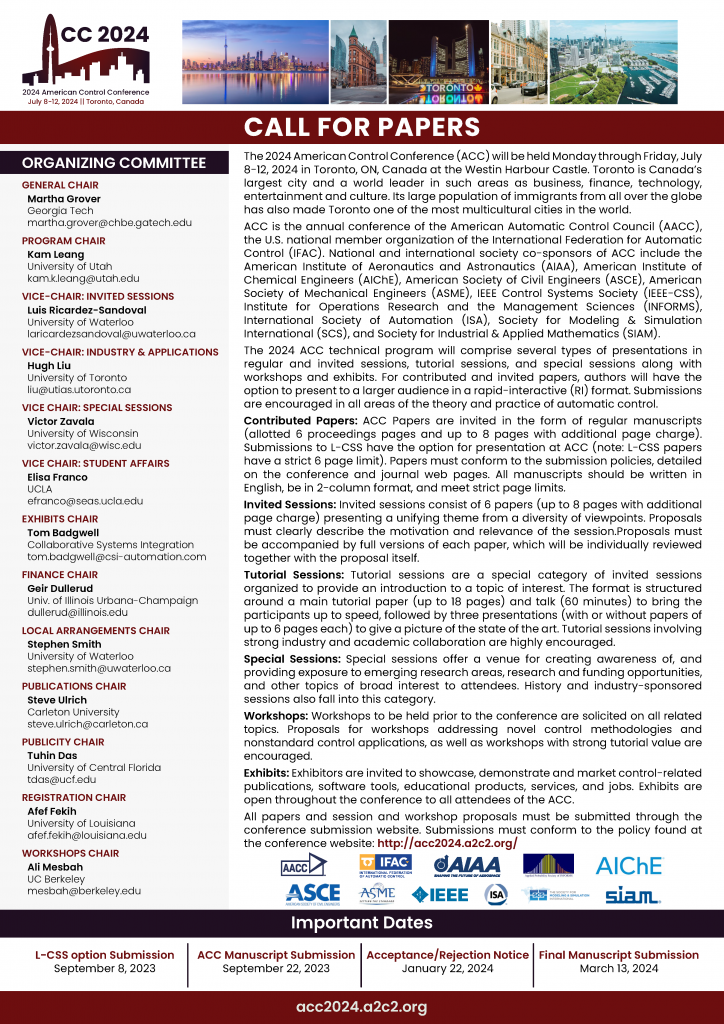
ACC will be held in Toronto, Canada, from July 8-12, 2024. The call for papers is attached for your convenience, and please visit the ACC’24 website: https://acc2024.a2c2.org/ for further details.
As the deadlines draw near, please note the following dates:
We are excited to announce that the Foundations of Computer Aided Process Design (FOCAPD) 2024 abstract submission system is now open. FOCAPD 2024 will be held July 14-18, 2024, at the Beaver Run Resort in Breckenridge, Colorado, USA.
FOCAPD is the premier international conference in the field of Chemical Process Design and is held only once every five years. The Computer Aids for Chemical Engineering (CAChE) Corp and the American Institute of Chemical Engineers (AIChE) are facilitating the conference jointly. The overarching goal of FOCAPD is to provide a unique environment for discussing the significant developments in Chemical Process Design since the last meeting in 2019, with a forward-looking perspective for the coming five years.
The conference program is organized around four themes:
Design and Energy Transitions – the transition from carbon-based energy sources or the design of non-traditional energy networks
Design and Sustainability – approaches to achieve process, product, and supply chain sustainability via carbon neutrality, circular design, etc.
Design and Emerging Fields – new areas such as Pharma, bio-systems, AI/ML, digital twins, etc.
Design Education and Future of Design – how and what to teach the next generation
We are inviting you to submit abstracts for poster presentations within these themes. In addition to papers focusing on these themes, research in general PSE design space is also welcome. The poster sessions, single-track and composed of contributed papers in FOCAPD, are a highlight of the event and showcase the state-of-the-art in Chemical Process Design and provide opportunities for exchanging ideas and discussions over extended periods.
The deadline to submit the one-page abstract prepared using the template linked to below is September 1, 2023. For further information and to submit your abstract, please visit the conference website at https://focapd.cache.org/submit-abstracts-focapd-2024.
We look forward to receiving your contributions.
Sincerely,
Thomas Adams, Matt Bassett, Selen Cremaschi, Monica Zanfir (FOCAPD co-chairs)
We cordially invite you to contribute to ADCHEM 2024, the 12th IFAC Symposium on Advanced Control of Chemical Processes, which will be held in Toronto (Canada) from July 14 to 17, 2024.
ADCHEM is a triennial symposium of the International Federation of Automatic Control (IFAC). It will bring together researchers and practitioners from all over the world to foster discussions of recent developments in the control and modeling of chemical, biomedical, and related process systems.
Key Dates
October 15, 2023
Invited Session Proposals due
October 31, 2023
Regular Papers, Invited Session Papers, and Industrial Extended Abstracts due
An IFAC Young Author Award will be awarded at the symposium in Toronto.
We look forward to seeing you in Toronto!
Best regards,
IPC Chairs Martin Mönnigmann, Ali Mesbah and Pablo Rolandi
NOC Chairs Christopher Swartz, Kim McAuley and Danielle Zyngier
——————————
ADCHEM 2024 is sponsored by the IFAC Technical Committee (TC 6.1) on Chemical Process Control and co-sponsored by the IFAC Technical Committees 2.3 Non-Linear Control Systems, 2.4 Optimal Control, 5.2 Management and Control in Manufacturing and Logistics, 6.2 Mining, Mineral and Metal Processing, 6.3 Power and Energy Systems, 6.4 Fault Detection, Supervision & Safety of Technical Processes, 8.2 Biological and Medical Systems, and 8.4 Biosystems and Bioprocesses.
ADCHEM 2024 follows the tradition of symposia held in Toulouse (1991), Kyoto (1994), Banff (1997), Pisa (2000), Hong Kong (2003), Gramado (2006), Istanbul (2009), Singapore (2012), Whistler (2015), Shenyang (2028) and Venice (2021).
The 2023 CSChE will be held in Calgary from October 29th to November 1st. This year, the Systems and Control Division Program will be organized as a Symposium by Prof Biao Huang and Prof Nicolas Hudon.
We received a fairly good number of abstracts for the Systems and Control Division Symposium by the June 19thdeadline. Thank you for your contributions so far.
Two important announcements about the symposium:
The invited keynote speaker for this year is Prof Prodromos Daoutidis (University of Minnesota) who will present a talk titled “Efficient solution of large-scale control and optimization problems: network science meets artificial intelligence”.
The DG Fischer lecture will be delivered by Prof Vinay Prasad (University of Alberta) who will present a talk titled “Decoding reaction complexity using process systems engineering”. Please join me in congratulating Vinay for the award!
As we are beginning the review process for the symposium: please contact Prof Nicolas Hudon (nicolas.hudon@queensu.ca) directly if you submitted your abstract by mistake to a different session (I know the names of some sessions were confusing), we will seek to get your submissions back to the Division’s program.
Finally, the organizing committee decided to grant an extension for submissions. The final deadline to submit your abstract to CSChE2023 is July 3rd, 2023. The website for the conference is:
To submit your abstract, use the Program tab under “Submit your Abstract”. When submitting your abstract, be sure to select “Systems and Control Division Symposium”, from where you will be able to select one of the four themes:
Chemical Process Modelling, Control, and Optimization
Statistical Process Control and Data Analytics
Artificial Intelligence and Machine Learning
PSE in Process Intensification, Energy Management and the Environment
Electronic submission of a single PDF file consisting of the nomination form, nomination letter, CV, and supporting letters/information should be sent to the CAST Second Vice-Chair, Selen Cremaschi, by April 17, 2023.
Thank you all for your nominations and your contributions to CAST.
The Department of Chemical Engineering (ChE) at the University of Waterloo invites applications from qualified candidates for a 12 month postdoctoral fellowship appointment in Optimal Operation of Emerging Energy and intensified Systems under the supervision of Professors Luis Ricardez-Sandoval.
The aim of this project is to perform optimal integration of advanced energy and CO2 capture systems applying process intensification principles. The candidates for this position must have solid expertise in computer programming, chemical process optimization, process control, and first-principles modelling of chemical systems. In particular, the candidate must have expertise in solving nonlinear dynamic optimization problems using state-of-the-art optimization software. A Ph.D. degree and evidence of excellence in research are required. Successful applicants are expected to maintain an active program of research in areas closely related to optimal process integration of energy and chemical systems. Applications should include a cover letter describing their interest in the position and the candidate’s background in the areas, a curriculum vitae and research statement and at least three reference letters.
There is no deadline to apply to this position and candidates will be evaluated until the position is filled. The selected candidate is expected to start working on the project at their earliest convenience. Interested individuals should send their application to Luis Ricardez-Sandoval (laricard@uwaterloo.ca). The salary for this position will be similar to that offered by the NSERC postdoctoral fellowship program and commensurable with the background and activities to be developed by the applicant. Only applicants that fit the profile outlined above for this position will be contacted.
The University of Waterloo regards diversity as an integral part of academic excellence and is committed to employment equity and accessibility for all employees. As such, we encourage applications from women, Indigenous (First Nations, Métis and Inuit) peoples, persons with disabilities, members of diverse gender identities, and others who may contribute to the further diversification of ideas. At Waterloo, you will have the opportunity to work across disciplines and collaborate with an international community of scholars and a diverse student body, situated in a rapidly growing community that has been termed a “hub of innovation”.